
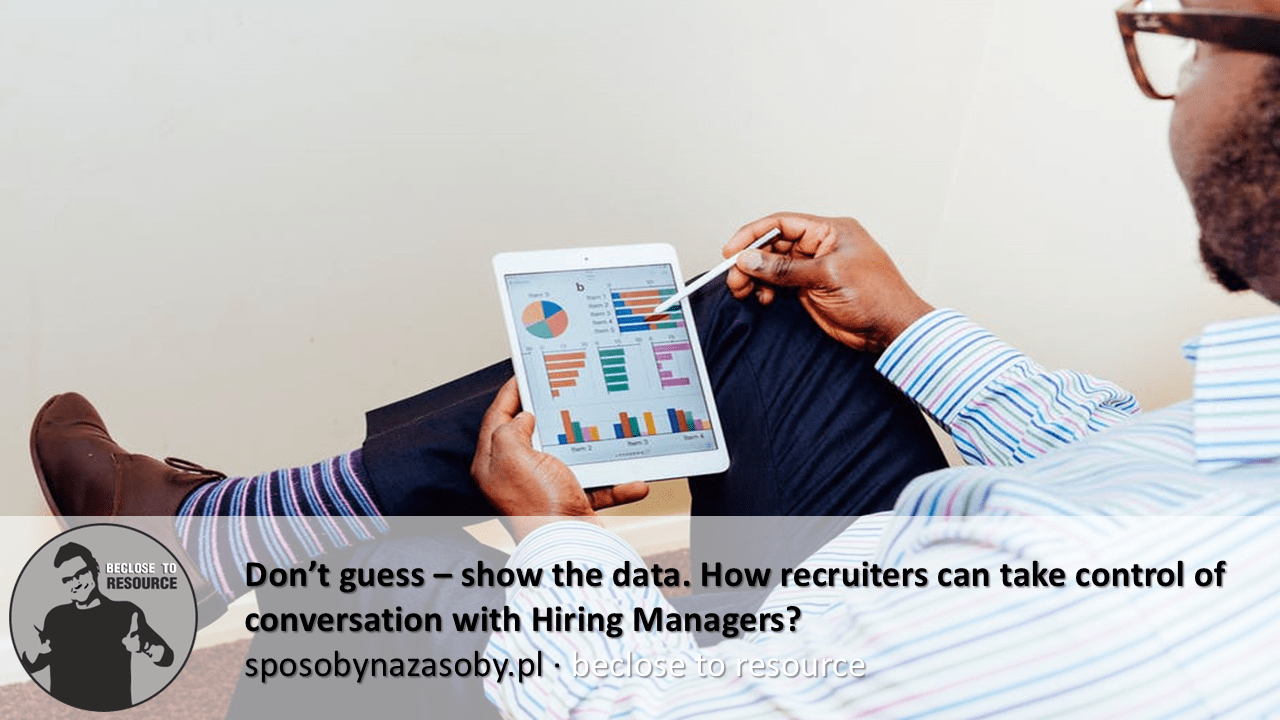
Just a few years ago, recruiters were often seen as executors, handling business needs with little say in shaping them. Today, that’s changing fast. Companies now expect Talent Acquisition professionals not only to deliver results, but also to think strategically.
Recruiters are increasingly earning a seat at the table with execs, function leads, and Hiring Managers to plan the company’s future together. What is at the heart of this shift? Data.
More precisely – the ability to interpret data, translate it into decision-ready language, and use it in real conversations with hiring stakeholders.

That’s what Market Insights are: not just a “report for the sake of a report,” but a tool for smarter, more strategic, and more effective hiring conversations.
Recruiting in market reality
Why do conversations with Hiring Managers every so often feel like pulling teeth?
Because we’re often operating from completely different assumptions. Managers envision the ideal candidate, without much awareness of reality: limited supply, rising salary expectations, or shifting candidate preferences. Sometimes not even understanding the skillset they expect.
The recruiter’s role isn’t to simply nod and take notes. The recruiter’s role is to bring real market context to the table, back it up with numbers, and collaboratively explore viable hiring scenarios.
Market Insights help ground expectations – professionally and constructively, not confrontationally. When you say:

“There are currently 17 companies actively hiring this profile in our region. The average salary expectation is 18,000 PLN gross, and only 6% of candidates are open to on-site work.”
That’s not an opinion. That’s a fact. And facts are difficult to argue with.
What makes a good market insight report?
This isn’t about creating a 40-slide PDF. A good Insight is supposed to be relevant and actionable, something that directly supports a hiring decision.
What’s worth showing?
- Candidate availability in a given region
- Number of active job ads for a similar profile
- Salary trends
- Who else is competing for the same talent
- Profile’s benchmark
If you’ve got historical data from previous roles — even better. But here’s the kicker: data alone doesn’t change anything – interpretation does.

A recruiter should be able to say what it means when, for example, candidate supply in data science dropped 15% last quarter, while salary expectations rose 10%.
So what now? Change the location? Adjust the role? Go hybrid? Raise the budget?
That’s where the real impact lies.
Where to get the data?
You don’t need to be an analyst or pay for expensive tools. Use:
- External platforms (LinkedIn Talent Insights, TalentNeuron, Horsefly, Glassdoor)
- Industry reports (Hays, Mercer, ABSL)
- Government data (Eurostat, BLS)
- Job board analytics
And don’t overlook what’s already in your hands: your ATS, excel trackers, reports from past projects, internal salary benchmarks – that’s a goldmine.
A smart recruiter knows how to stitch together a coherent, persuasive story from multiple sources.

How to talk to a hiring manager so you actually have influence
The conversation starts before you show any charts.
First – understand what matters most to the manager: Time? Quality? Cost? Strategic importance?
Then – pick the right data to help them make an informed decision.
During the meeting, you’re not “presenting slides” – you’re telling a story:
“What’s happening?”
“What does it mean?”
“What can we do about it?”

Always close with a clear recommendation: one, two, or three scenarios – even if they’re uncomfortable truths, like:
- Change the location
- Loosen requirements
- Increase budget
- Hire a junior with potential and plan for upskilling
Want to be seen as a partner? Act like one.
The best recruiters don’t wait to be asked. They provide data proactively. Sometimes even during the kick-off they’ll say: “It’s worth considering X, because of Y”. That’s not overstepping – that’s professionalism.
Data culture starts with you
In many companies, decision-making in recruitment still isn’t data-driven. Good news: that means you have the chance to change that.
Every well-prepared report, every fact-based conversation, every successful collaboration – it all builds your influence and the trust business leaders place in you.
Market Insights aren’t just reports. They’re the language recruiters use to communicate with the business.

Want to learn how to create market insights from scratch?
I run practical trainings for recruiters and Talent Acquisition teams. I teach how to gather, analyse, and use labour market data – from kick-off meetings with Hiring Managers to final hiring decisions.
If you want to start building your own Market Insights or level up your team’s skills – don’t hesitate to reach out.
If you represent a company, let’s talk about a custom training for your TA team.
A Big thank you to my amazing peer Ola from Kursy języka angielskiego online – ATL English by Aleksandra Ammer for her support and proofreading!
 Sposoby Na Zasoby | Beclose to resource
Dodaj komentarz